Warwick Local History
Warwick, New York: A Nostalgic Journey from Founding to Today
A 19th-century painting by local artist Jasper Cropsey depicts Warwick's rolling valley beneath Sugar Loaf and Mount Adam, capturing the serene rural beauty that has enchanted residents and visitors for generations. The story of Warwick, New York unfolds like a patchwork quilt of American history – from its frontier beginnings and Revolutionary fervor, through a golden age of railroads and resorts, to the cherished community traditions of today.
Nestled in a fertile valley in southern Orange County, Warwick has evolved over three centuries while preserving a timeless pastoral charm. Each chapter of its past is filled with memorable characters, innovations, and enduring landmarks that together create a delightful, living tapestry of heritage. Let us wander back in time and explore Warwick's journey from humble colonial settlement to the vibrant small town it is today, savoring the anecdotes and milestones that make this town's history truly unforgettable.
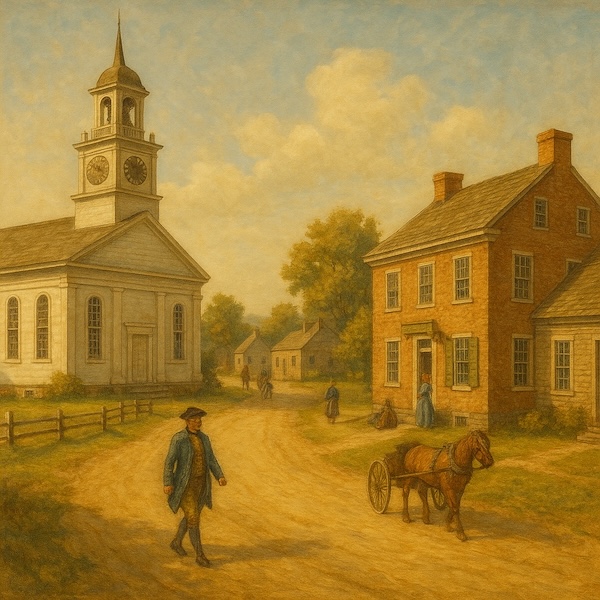
A pastoral view of Warwick's valley and early village life.
Early Days in the Warwick Valley (1700s)
Long before war or railroads touched this tranquil valley, the region was hunting ground for the indigenous Lenape people. European colonists arrived in the early 1700s, drawn by fertile land. In 1702, a large tract called the Wawayanda Patent was secured from native leaders, paving the way for settlement.
The first permanent settler on record was Johannes Wisner (Weesner) and his wife Elizabeth, a Swiss couple who ventured from Long Island in 1712 to farm 200 acres near modern Edenville. Around that time, one absentee landowner, Benjamin Aske, named his tract "Warwick" – presumably after an English locale near his ancestral home – and in 1719 he began selling parcels to incoming farmers.
The very first sale was 100 acres to a man named Lawrence Decker, and soon other hardy families followed, bearing surnames like Baird, Burt, DeKay, and Wheeler that still echo through local history. These pioneers hewed farms from forest, their rough cabins and taverns forming the germ of a community.
Historic Landmarks from the Colonial Era
- The Shingle House (1764) - Warwick's oldest structure, a humble saltbox home where colonial-era life comes alive
- Baird's Tavern (1766) - Where colonial debates and defiance pulsed
- General John Hathorn's stone house (1773) - Home of the beloved schoolteacher turned militia leader
By mid-century, scattered homesteads had grown into small hamlets connected by dirt roads. Warwick Village started around about 1764 as a crossroads settlement, joined by outlying hamlets such as Florida (then called Brookland, settled 1730) and Bellvale (originally Wawayanda, 1740).
Early Warwick farmers prospered through simple industries: they milled local timber, forged iron in small bloomery forges, and distilled applejack brandy from abundant orchards (especially after 1765, when colonists boycotting British imports made applejack a profitable patriotic substitute for rum).
Revolutionary War Connections
Warwick's Sterling Iron Works contributed mightily to the war effort: its forges produced links for the massive chain that stretched across the Hudson River to block British ships. Conrad Sly of Warwick helped supervise the creation of this 186-ton iron chain in 1778 – a pivotal factor in protecting the colonies.
When General George Washington passed through Warwick in the summer of 1783, he paused to sip a mug of grog at Baird's Tavern and spent the night at Colonel Hathorn's home. One can easily imagine the scene on that July day: the war-weary commander, welcomed by villagers as a hero, raising a toast in the cozy taproom while sharing news of peace.
"Painted Ladies" and Railroad Days (1800s)
Through the first half of the 19th century, Warwick remained a quiet farming hub dotted with water-powered mills and blacksmith shops. In 1845, author Henry William Herbert – writing under the pen name Frank Forester – published The Warwick Woodlands, a popular tale of rural sport that introduced readers to the lush forests and streams of Warwick.
Change truly arrived with the railroad: in 1862 the Warwick Valley Railroad opened, linking the town by rail to the main line in Chester and ultimately to New York City. In a flash, Warwick's isolation was over. Now city dwellers could reach the valley in a few hours instead of a day's carriage ride, and local farmers gained speedy access to urban markets.
The Golden Age of Tourism
Wealthy visitors soon arrived by train to savor Warwick's pastoral scenery and fresh mountain air. Some were so enchanted that they built lavish summer estates – ornate Victorian mansions nicknamed "Painted Ladies" for their gingerbread trim and colorful facades.
- The Red Swan Inn (1903) - A sprawling gabled resort with turrets and broad verandas
- Wawayanda House - Bustled with summer visitors
- Warwick Valley House - Another popular establishment for trainload tourists
Under the leadership of railroad entrepreneur Grinnell Burt, the humble Warwick Valley Railroad pioneered innovations that made national history – it became the first line in America to use refrigerated railroad cars to ship fresh milk from dairy farms. This meant that Warwick's rich milk and produce could reach New York City without spoiling, further enriching local farmers.
Famous Residents
Among Warwick's notable residents was Jasper Francis Cropsey, a renowned painter of the Hudson River School who made Warwick his home in the 1860s. Cropsey built a hilltop mansion (on what is now Pennings Orchard) and spent days capturing the local landscape on canvas – golden light on the hills, mist over Glenmere Lake, autumn splendor on Sugar Loaf Mountain.
Meanwhile, the neighboring Greenwood Lake area – part of the town of Warwick – developed into a Gilded Age playground of its own. By the late 1800s, dozens of grand lakeside hotels and inns dotted the shores of Greenwood Lake, welcoming vacationers who arrived via a special spur of the Erie Railroad. Celebrities of the era, including baseball legend Babe Ruth and actress Greta Garbo, could be spotted in summer months enjoying the lake's breezes and nightlife.
Trials, Transitions, and Preservation (1900s)
The dawn of the 20th century saw Warwick's "golden age" slowly fade into new challenges. The 1910s and 1920s brought the disruptions of world war and economic upheaval. The late 1920s ushered in the Great Depression, which hit Warwick's agricultural economy hard. Crop prices plunged, banks failed, and some farmers lost their land when they could not pay taxes.
Yet the community persevered. In the 1930s, President Roosevelt's New Deal programs reached Warwick, providing relief and jobs. Federal crews drained swamps in the fertile "Black Dirt" lowlands (near Pine Island) to expand onion and celery fields, and built new infrastructure.
New Deal Projects in Warwick
- Route 17A carved over Mount Peter (mid-1930s)
- Warwick Municipal Airport (Works Progress Administration project)
- Improvement of country lanes like Kings Highway
- Black Dirt swamp drainage for expanded farming
World War II saw another generation go off to fight, and afterward Warwick – like much of America – underwent profound social change. The postwar boom from the 1950s into the 1970s brought new residents in search of fresh air and affordable homes. Many were families moving up from New York City or New Jersey, transforming parts of Warwick into a semi-suburban community even as dairy cows still grazed on nearby hills.
This infusion of newcomers also spurred Warwick to protect what made it special. In 1906, a Historical Society had already been founded to preserve landmark buildings; by mid-century, interest in local history surged anew, ensuring that treasures like the 1764 Shingle House and 1810 Old School Baptist Meeting House were saved from decay.
Warwick Today: Tradition and Community Spirit
Stepping into present-day Warwick, one immediately feels the conversation between past and present. Farms still checker the countryside – from orchards where families pick apples each autumn, to the famous Black Dirt Region where generations of onion farmers coax bounty from jet-black soil rich with centuries of peat.
Applefest: A Modern Tradition
Perhaps nothing embodies this better than the annual Applefest, a massive harvest festival launched in 1989 that now draws up to 35,000 visitors each October. What began as a humble local fair has grown into one of the top-ranked festivals in the nation, honoring Warwick's apple-growing legacy with stands of fresh cider, homemade pies, craft vendors, music, and old-fashioned games.
Throughout the year, Warwick maintains a busy calendar of events that blend fun with history. Residents commemorate George Washington's 1783 visit each summer with a jovial 5K race and colonial costume festivities, raising a tankard at Baird's Tavern in memory of the General's famed grog stop.
Modern Warwick has also become known for its boutique wineries, farm markets, and an active arts scene – yet it remains at heart what it always was: a close-knit rural community that treasures its natural beauty and storied past.
From the days when Johannes and Elizabeth Wisner planted their first crops along the trickling Wawayanda Creek, to the whistle of the first train bringing newcomers and opportunity, to the bustling Applefest of today, Warwick's narrative is rich with resilience and charm. It is a place where old stone inns and quaint Victorian houses are not just preserved as museums, but continue to be lived in and loved; where legends of patriots and outlaws are retold around bonfires; and where each generation adds new chapters without forgetting the old.