Self-guided village route
Historic Warwick, NY Village Walking Tour
This self-guided walking tour in Warwick, NY takes you through the historic Village of Warwick, visiting 15 historic locations. You'll start at one end of Main Street and stroll past centuries-old buildings, landmarks, and sites rich with local history. The tour loops through the village's compact downtown, so you can easily walk from one point to the next.
For convenience, we've grouped nearby stops into segments. Each segment includes multiple historic sites within a short walk of each other. (Estimated total walking time: about 1 to 1.5 hours, including brief stops.)
Segment 1: Main Street (South End) – Masonic Lodge to Village Hall
(Est. ~30 minutes)
Begin at the south end of Main Street in Warwick, NY, and head north (toward the center of the village). In this segment, you'll encounter several 19th-century buildings that highlight Warwick's growth after the arrival of the railroad in 1860:
Masonic Temple (17 Main St.)
This three-story brick structure was built circa 1870 and originally housed shops on the ground floor. The local Masonic Lodge began renting the top floor in 1878 and eventually purchased and remodeled the building in 1923. You can still see the Masons' emblem (square and compass with a "G") displayed on the building's south side.
Warwick Valley Telephone Co. Building (47 Main St.)
Prior to the founding of the Warwick Valley Telephone Company in 1902, the entire town shared a single public telephone in a Main Street drugstore. This brick building became the telephone company's headquarters (opened in 1949) and symbolizes Warwick's early leap into telecommunications. Today, the historic phone company building at 47 Main is still in use, now serving as offices for a modern fiber-optic provider.
Warwick Savings Bank (TD Bank Building) (51 Main St.)
A solid brick bank building constructed in 1926, it originally housed the Warwick Savings Bank. The bank itself was founded in 1875 by prominent local businessman Grinnell Burt. (Burt was also the first president of the Warwick Valley Railroad.) The bank operated here until 1974, when it moved to a larger location on Oakland Avenue. The carved Roman numerals over the door ("MDCCCCXXVI") mark its 1926 construction. Today a TD Bank branch occupies this historic structure.
"Clocktower" Building (65–67 Main St.)
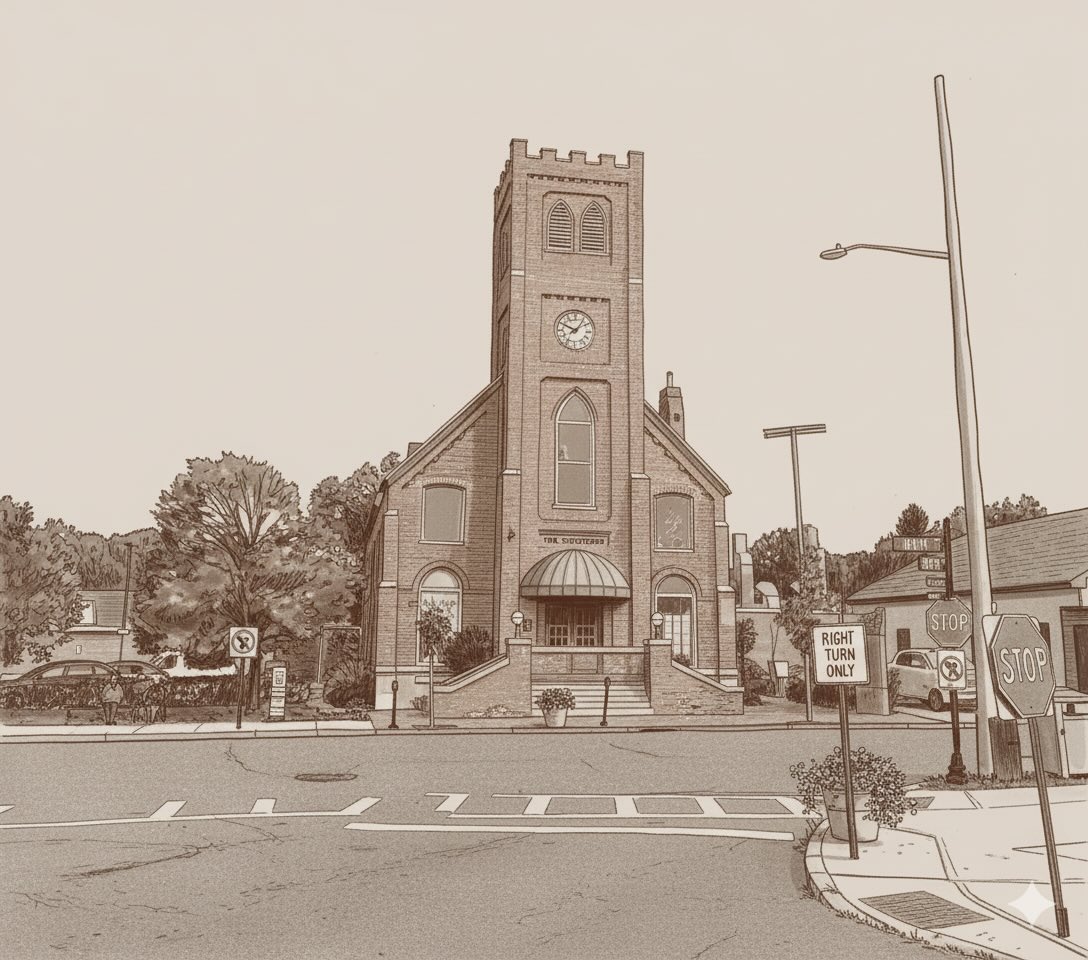
This building started out in 1867 as the Warwick Methodist Church. It once had a towering steeple twice the height of the current tower, but after multiple lightning strikes the tall steeple was removed in 1917 and replaced with the shorter clock tower that gives the building its nickname. The former church's distinctive bell tower (with clock faces) remains a visual landmark on Main Street. (Today the building houses shops and offices, but locals still call it "Clocktower.")
C.B. Cline House (75 Main St.)
A wood-frame clapboard house built around 1830. It became the home of C. B. Cline, a local cabinetmaker, in 1875. Uniquely, craftsmen like Cline often served as undertakers too – using their carpentry skills to make coffins as well as cabinets. By the mid-20th century this house had even served as a funeral home. It's one of the few early residential structures still on Main Street (most old homes here were later replaced by commercial buildings). Today, the restored house serves as Warwick's Tourist Information Center, preserving a bit of the residential streetscape of bygone days.
Village Hall (77 Main St.)
Notice the Greek Revival style: a white facade with a row of tall columns and pediment. This building actually began as a church – the Dutch Reformed Church built in 1848 at 16 Maple Avenue. In a feat of 19th-century engineering, the entire structure was moved on rollers to Main Street in 1890, after the congregation merged with another. The Village of Warwick purchased it in 1908 to serve as Village Hall. Standing here, you are at the very heart of the "Queen Village" of Warwick. (Indeed, the Village Hall and adjacent Information Center at 75 Main are often where community events and tours begin.)
Travel Note
As you continue north on Main Street, you'll pass the site now occupied by a Dunkin' Donuts (93 Main St.). In the 19th and early 20th centuries, this stretch between Wheeler Ave and the old tavern had two large Victorian homes. They were demolished in 1957 to make way for an automobile dealership – a mid-century change that reflects how the automobile age altered small downtowns. (If you look up at the Dunkin' building, you can spot "1957" inscribed high above the entrance, marking its construction.)
Segment 2: Main Street (North End) and Lewis Park – Tavern & Town Green
(Est. ~20 minutes)
Segment 2 covers the historic junction of Main Street and Colonial Avenue/Kings Highway – the north end of the village's main strip. Here you'll find one of Warwick's oldest buildings (an 18th-century tavern), a landmark fountain, and the village green with several historic society properties. This area is very walkable: all sites are within a block or two.
Baird's Tavern (103 Main St.)
This iconic stone tavern was built in 1766 by Francis Baird, making it one of the oldest surviving buildings in Warwick. Its strategic location at the junction of roads to Newburgh, Goshen, and New Jersey made it a favored stop for travelers in the colonial era. George Washington is noted to have paused here during the Revolutionary War, and his wife Martha Washington even spent the night on July 27, 1782. Over the centuries, Baird's Tavern served as an inn, private home, general store, and more. In 2021 it was restored and reopened as a working tavern once again – so visitors can once more eat and drink by its 18th-century hearth. (The tavern is typically open to the public in the evenings.) — This building is owned by The Historical Society of Warwick, New York
Sanford Memorial Fountain (traffic island at Main St. & Church St./Kings Hwy)
At the little triangular green where Main Street meets Kings Highway, you'll see an old stone horse-watering fountain. This was placed in 1903 by the children of George W. Sanford, a local bank president, in honor of their father. In the days of horse-drawn carriages, this fountain's trough provided fresh water for thirsty horses traveling through the village. It's a quaint reminder of Warwick's turn-of-the-century era. Here Main Street meets Kings Highway – a name dating back to colonial times. In the 1700s, any road designated as a "King's Highway" was an official travel route; property owners along it were required by law to maintain the road. Typically such roads were cleared wide enough for 10–12 men to march abreast. Standing by the fountain, you are literally at a crossroads of history: the colonial King's Highway running north-south and Warwick's Main Street running east-west.
Old School Baptist Meeting House (Lewis Park, near High St. & Church St.)
Perched on a small knoll in the adjacent Lewis Park stands the most famous church in Warwick: the Old School Baptist Meeting House (built 1810). Its elegant white steeple can be seen from almost anywhere in the village, a classic New England–style meeting house on the green. The Baptist congregation here was founded in 1765, and they erected this church in 1810 using local timber and the designs of Deacon John Morris Foght. Services were held here for well over a century, but by the 1950s the dwindling congregation could no longer maintain the structure. Fearing it might be demolished, the Warwick Historical Society intervened – and in 1952 the Society acquired the building for $1, pledging to preserve it forever. Today the Meeting House is lovingly maintained as a museum and event venue. (If the building is open, step inside to appreciate its simple interior and acoustics – it's often used for weddings and concerts.) Take a moment to enjoy Lewis Park as well, which was donated to the town by the Lewis family and today is a public green space hosting community gatherings. You'll also notice several other historic structures around the park: for example, the 19th-century Sly Barn and a 1909 Lehigh & Hudson River Railway Caboose (relocated here in 1979) are on the society's campus behind the church. — This building is owned by The Historical Society of Warwick, New York
A. W. Buckbee Center (Old 1927 Library) (2 Colonial Ave.)
A short detour around the corner on Colonial Avenue brings you to this stately brick building (it's adjacent to Lewis Park, just a 1-minute walk from the fountain). Built in 1927 with funds donated by Mrs. Albert Wisner, this was Warwick's public library for many decades. Its design is Colonial Revival with a grand entrance – a symbol of the community's pride in literacy and learning. When the library moved to a new facility in 2010, local philanthropist Albert Buckbee purchased the old building and gifted it to the Historical Society. Now it serves as the A.W. Buckbee Center, home to the Warwick Historical Society's archives and a venue for exhibits and events. (If you're visiting on a weekday, the Buckbee Center is often open mid-day for visitors, as the Historical Society's office hours are generally 10 a.m. – 2 p.m., Monday through Friday.) — This building is owned by The Historical Society of Warwick, New York
Main Street Crossing & Post Office (108 Main St.)
Returning to Main Street, take care at the pedestrian crosswalk by the fountain. On the opposite side of Main Street you'll see the U.S. Post Office for Warwick (a low brick building at 108 Main). Interestingly, this is one of the newer structures on the street – it was built in 1967, long after the rest of the historic district was established. Its mid-20th-century Federal-Colonial Revival style (with a cupola and brick facade) tries to blend in, but locals note that it's not as old as it looks. From here, begin walking southward down the east side of Main Street (the side with the Post Office) to start the return leg of the tour (Segment 3).
Segment 3: Main Street (East Side, Heading South) – Return Route to Railroad Green
(Est. ~30 minutes)
In this final segment, you will walk back toward the south end of the village along the east side of Main Street, covering the remaining historic buildings. This side of the street features a mix of early 19th-century homes, later commercial buildings, and a few modern structures, all part of the Warwick Village Historic District (listed on the National Register of Historic Places in 1984).
100–104 Main Street: From Historic Hat Factory to Today's Dining & Shops
100 Main Street – John McKee's Hat Shop
This historic address was once the bustling center of John McKee's early 19th-century hat manufacturing business and family residence. McKee was one of Warwick's prominent craftsmen, running both a hat shop and workshop from this location during the village's early commercial period. Hat-making was a crucial trade in the 1800s, as hats were essential daily wear for both men and women, and skilled hatters like McKee served the entire region. The building housed both his family's living quarters and the commercial space where he crafted and sold his handmade hats to local residents and travelers passing through the village. Today, the space continues its tradition of serving the community as 100 Main Restaurant, an acclaimed Italian/Mediterranean restaurant known for its warm ambiance and artisanal approach to cooking.
1810 House (80 Main St.)
This charming saltbox-style house, built 1810–1812, is one of Warwick's gems. Architecturally it's a Federal-era home with the classic "Connecticut saltbox" shape (a long, sloping rear roofline). Inside, it still has some original detail like wide-plank floors and hearths. Over the years, this house has worn many hats – it was once a private residence, later served as the town's YMCA, and even as an early library. It eventually came under the care of the Historical Society: today the 1810 House hosts the Society's administrative offices, local history gift shop, and small exhibits. (If open, you might peek in to see the Herb Wheel Garden in the back yard, a beautifully designed herb garden maintained by volunteers.) Fun fact: The Shingle House (Warwick's oldest house from 1764) is located just behind here at 7 Forester Avenue. If you have extra time and walk a short block east on High Street, you can see the Shingle House complex, including the old house, an 1825 barn, and that 1909 caboose mentioned earlier – all part of the Historical Society's museum properties. — These buildings are owned by The Historical Society of Warwick, New York
John W. Sanford & Son Building (60–64 Main St.)
As Main Street curves gently here, you'll encounter a unique triangular brick building at the junction of Main, South, and High Streets. This flatiron-shaped structure was originally built in 1870. After a devastating fire in 1879, it was rebuilt around 1880 with the handsome three-story brick design you see now. In its early years, this building marked the arrival of Warwick's first U.S. Post Office on its ground floor (back when mail came by train). By 1890 it housed the John W. Sanford and Son Insurance Company, which remained here for many years. The building's pointed corner and decorative brickwork make it a standout. It's often photographed as Warwick's own little "Flatiron." Today, it contains shops and offices – a great example of adaptive reuse of a 19th-century commercial building.
Crissey Building (56–58 Main) and I.O.O.F. Hall (50–54 Main)
These two adjacent structures are next along the block. The Crissey Building (c.1900) served as commercial space and was once one of the sites of the Warwick Savings Bank during the bank's early years. The bluish-gray building next to it, 50–54 Main, dates to around 1860 and is known for the large white letters "IOOF No. 34" on its facade. Those initials stand for Independent Order of Odd Fellows, a fraternal organization similar to the Masons. Warwick's Odd Fellows lodge was chartered in 1867, and they met on the third floor of this building.
W.T. Anderson Building (40 Main St.)
This impressive three-story brick building was constructed in 1890 by William T. Anderson. It showcases elements of the Romanesque Revival style popular in late 19th-century America – look for the rounded arch windows and robust masonry detailing. Anderson ran it as a large department store in the late 1800s, catering to the prosperous "boom years" of Warwick when the railroad brought commerce to town.
Chase Building (First National Bank) (30 Main St.)
Finally, we come to the end of the tour at the Chase building on the corner of Main Street and Bank Street. This stone-and-brick structure occupies the site of Warwick's First National Bank, which was founded in 1864. Back in the railroad era, the bank's location was prime: the train freight yard was just behind here (where the parking lot is now), so merchants and farmers would come straight from the trains to the bank. In its heyday, this bank boasted an elegant lobby serving the bustling produce and dairy trade of Warwick's farms. The building has since been restored and now houses The Fed of Warwick—a restaurant and bar that preserves the former bank's grand interior—while the historic core remains part of the streetscape; the Chase branch has relocated to 146 US Highway 94 S.
End of Tour – Railroad Green
The Railroad Green park is just steps away, across Bank Street. This small green (with a gazebo and benches) was once part of the busy railroad station area. It's now a lovely public park where Warwick hosts concerts and events. You'll also see an eye-catching red caboose on the far side of the green – this is the Chamber of Commerce Visitor Center, cleverly housed in a 1908 vintage caboose. It's a fitting tribute to Warwick's railroad heritage and a fun final stop.